
Translating Trends into Salty Snacks
From Food Product Design Magazine
Table of Contents
Inspiration sources
Flavor creation
Up-and-coming flavors
Enduring flavors
Functional issues
Nutrition factors
Labeling issues
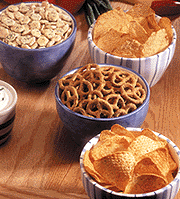 The snack food market is changing. More and more companies that have not traditionally been players in the snack-food market are producing snack foods. For example, companies such as Minneapolis-based General Mills are trying to capture part of the salty-snack market, which amounted to $18 billion (not even including cracker sales) in 1998, according to the Snack Food Association, Alexandria, VA.
With snacks, much as with other foods, tracking trends is a necessary part of grabbing a share of this lucrative market. Once trends are identified, it's time to put this new found knowledge to good use. So, how do new and ever more flavorful salty snack products move from ideation to the store shelves?
Many new products are actually variations on existing items. A brand new product with no history usually involves a large capital expenditure, and can be quite risky. A new product that does not do well could end up costing the company a lot of money, so many snack manufacturers find it much easier and less expensive to build on existing brands by varying color, flavor, shape or packaging.
Flavors arrive on the market via different means. For many snack producers and flavor suppliers, new product ideas come from employees, magazine articles and various other sources. One hot spot for trend-watching is restaurants - popular food concepts in restaurants may prove to be good snack-flavor concepts. For example, look at mesquite barbecue, hot wings, and one of the most successful restaurant-to-snack transitions, nachos.
There are methods to take some of the guesswork out of restaurant trend-watching. "Working in conjunction with the Foodservice Research Institute, Inc., Oak Park, IL, we have developed Flavor Track, a restaurant monitoring system which tracks menu mentions, looking at 31 different measures in different categories of restaurants," says Jerry Braun, director of marketing at Newly Weds Foods, Inc., Chicago. The restaurants are broken down into categories such as cutting-edge, family-dining chains, mid-scale chains, and quick-serve establishments. The system keeps track of various entrees, meat types, sauces and other constituents of restaurant menus, allowing deductions and judgments to be made about the popularity of certain ingredients and flavor trends. Mentions of more exotic foods might be made more frequently on the menus of cutting-edge restaurants, which are usually individually owned, and have an upscale style catering to consumers with a somewhat sophisticated palate.
Of course, not all popular restaurant items become snacks, and many times hot food trends are a moving target. Some concepts stay popular longer than others, and many times, when a trendy snack product hits the shelves, that concept may be already on its way out in the restaurants.
In addition to restaurant foods, snack ideas come from other product categories as well. Many times, a popular flavor concept crosses from one food category to another. Also, flavor ideas are not category specific. Edie Anderson, vice president of corporate communications for Pepperidge Farm, Inc., Norwalk, CT, says that "new snack products can be created using the 'different-familiar' concept. The different-familiar concept means taking a known flavor and placing it in a different category." For example, if an apple-pie flavor is hot in the breakfast-cereal category, snack manufacturers may decide to try it in a cracker or chip product. This concept can open up the arena to a wide range of new ideas.
Not only can a flavor cross from one category to another, but products themselves are making leaps into the snack market. Any number of breakfast-cereal packages display recipes for snacks made using their contents. Many of these recipes have become classic traditions in households, and companies are not only producing the ingredient, but the snack recipes as products themselves - Chex Mix and Rice Krispies Treats are prime examples.
Consumers also have country-specific and region-specific preferences for snack flavors. For instance, the United Kingdom has a wide variety of snacks based on the very popular cuisine of India, in addition to the ever-popular salt-and-vinegar and smoky bacon flavors seen less frequently in the United States. While the flavors of the Far East, from China to Thailand, present some interesting possibilities, they have not yet taken hold as widely popular snack concepts in this country. In Korea, squid, roasted cuttlefish and kimchi might be appreciated flavor concepts, but do not have much of a chance in the U.S. market at this time. More mainstream Eastern flavors, such as teriyaki or a peanut-flavored satay, might be an easier sell.
So how can a food trend be translated into a snack product? Start by sorting through some food concepts and choosing a few flavors. Consumer tests can decide whether there might be any interest in a certain type of cracker - let's say, for example, a snack cracker based on the concept of a roasted-vegetable quesadilla. The first step for the marketing department would be to ask a few questions about the roasted-vegetable quesadilla concept, such as: What is it about this dish that people like - the peppers, the mushrooms, the onions? Or perhaps the garlic or the cheese? What are the high notes in the quesadilla? The flavor notes might be salty, savory, spicy or smoky, in addition to grilled. The components of the dish can be broken down one by one to determine how the flavors interact to give the quesadilla that overall taste profile.
The consumer tests could show whether a snack product flavored as a roasted-vegetable quesadilla would be well received, and after initial development, a sensory evaluation questionnaire might ask if the cracker product does in fact taste like a quesadilla. Consumer testing can also provide information on specific flavor modifications or direction, for example, whether the flavor is too salty, too cheesy, or just right. Then the formulation can be altered as necessary before bringing the final product to market for the real test. These issues require good communication between the manufacturing R&D team and a flavor house.
When creating a new snack-flavor profile, producers often find it helpful to work closely with a flavor house to create unique flavor profiles. The process can take several routes, but often it's a combination approach. Flavor houses generate ideas and product concepts based around both their flavoring strengths and their creative talents; snack manufacturers also have development teams and marketing departments that work together with flavor and seasoning suppliers.
Creation of new flavor profiles by suppliers can be either reactive or proactive. They often create flavors to fit specific customer requests, but will also carry their own portfolio of distinctive flavors. In either case, flavor suppliers need to know what ingredients are popular with consumers for flavoring and labeling concerns. The ingredients and their required application levels also need to meet the cost constraints of the snack manufacturer.
According to a survey taken by the Snack Food Association, the top six flavor categories that snack-product manufacturers are interested in for 1999 are: hot-and-spicy, onion-and-garlic, ranch, honey mustard, barbecue, and cheese, in that order. The survey also indicates that some of the newer flavors manufacturers would like to see from seasoning suppliers this year include chili-and-lime, salsa-and-cheese, cinnamon, hot chicken wing, and hot-and-spicy cheese flavors. Other requests in this category are applesauce, garlic-and-vinegar, crab, honey, coffee, maple barbecue, and roasted garlic.
Generally, small companies tend to produce more snacks with exotic flavors, such as crab-flavored chips or cheeseburger chips, but even big players such as Plano, TX-based Frito-Lay offer lime-flavored tortilla chips and Smoky Red BBQ Doritos. The snack industry in general is starting to incorporate more Mexican, South American and other spicier flavors as these cuisines become more "everyday" for U.S. consumers.
Another popular flavor trend today is using variety to create difference. Says Anderson, "the trend in snack flavoring is distinctive in that specific flavors with strong profiles are big." Consumers are getting braver, and are expecting stronger, more exotic snack flavors. For instance, a chili-pepper-flavored snack may evolve into a line of snacks with hot flavors ranging from ancho to habanero.
Varietals are the rage within any ingredient category - they indicate that there's something special about the ingredient. Some companies offer a range of options within a flavor family, such as vidalia or Maui onion flavors. In products that seem more like commodities, using varietals creates points of difference where previously none existed. Cheese flavors are differentiated into Cheddar - or even New York Cheddar - Parmesan, bleu and others. Enzyme-modified cheese flavors are sometimes used to give a burst of flavor in the first bite, a popular phenomenon today.
As a flavor, cheese is certainly not disappearing - it's widely available, has great taste potential, is available in many variations and flavor possibilities, and is versatile in a number of flavor profiles. Cheese continues to be very popular, and few flavor ingredients match its versatility. Sour cream-and-onion is also a big flavor with staying power, as is barbecue and its variations.
Another increasingly necessary component in snack flavor profiles is heat from capsicum, such as that in chili peppers. Chili peppers are used in great number in cuisines such as Chinese, Indian, Mexican, Spanish, Thai and many African and South American cuisines. Chili peppers come in over 200 varieties, which vary in size, shape, color, flavor and heat intensity. Generally, the larger the chile, the milder it is. Small chiles are hotter because they contain proportionally more seeds and veins, which contain capsaicin, the alkaline compound that gives chiles their fiery nature. Cooking or freezing will not lessen the intensity of the chile; the only way to do this is to remove the seeds and veins.
Salt acts as both a flavor and a flavor enhancer. It is the essence of flavor on a pretzel surface, yet brings out the flavor of many snack bases such as corn, potatoes and nuts. Although concerns with high sodium intakes have decreased the amount of salt in some products, salt is still a versatile and important snack ingredient.
Choosing the right flavor is only the first step. Careful design of the system increases the chances for success.
"The biggest thing with snacks is to have a good strong flavor that will hold up over the shelf life of the product. Often this means using artificial flavors, which tend to last longer than the delicate natural flavors," says Ruth Kaan, product development manager at SpiceTec Ltd., Carol Stream, IL. "While natural flavors look good on the label, they can dissipate faster than artificial flavors, a prime example being sour cream-and-onion." Additionally, "clean" labels, or those with all-natural flavors, do not seem to be of high priority for most snack eaters.
Granulation, or particle size, affects the end result. Typically, the smaller the particle size, the better the adherence properties of the seasoning to the snack. It is also important when spraying on a flavor or seasoning that the particles are not so big that they clog the sprayer. Most snacks use flour salt, which is a very finely granulated salt; some also use a coarse salt on the top of a cracker for appearance and taste.
Often, processing issues require modifications in the flavoring and other parts of the formula. For example, when using tomato powder as part of the base formulation, the sugars would make it likely to burn and darken when exposed to the heat required in snack processing; therefore, a tomato flavoring would probably be advisable.
Another factor when formulating snacks, besides flavor, is the form and production method. Is it better to create a cracker, chip, bar, puff or something in between? The production method and type of snack will affect the manner in which the flavor is incorporated into the snack as well as the flavor perception in the finished product.
Many times the fat content of the snack affects the flavor application method. A fried snack will have a fat layer on the outside surface, making application and adherence of dry seasonings easier. Manufacturers sometimes spray the surfaces of grain-based non-fried snacks, such as baked wheat crackers or extruded corn curls, with a thin film of oil to enhance adherence of dry seasonings. If a low-fat snack needs to forgo the oil, suppliers have developed starch/gum adhesion systems that can be sprayed on before applying the dry seasoning. But because these are water-based, they can require an additional drying step to maintain the low moisture level required for crispness. Applying dry seasonings as in the above examples usually calls for a tumble drum, and works best when the snack is still warm from the fryer, oven or extruder.
Snacks account for a growing proportion of consumer's diets. This presents both an opportunity and a responsibility to snack manufacturers to provide healthy snacks for all ages. The healthy-snack concept remains strong, with low-fat products and those with an overall lower salt content making a strong showing in the market.
Nutraceutical components have cropped up in some niche snack products. Current snack innovations range from serious, medically oriented products to those with a more whimsical bent. Battle Creek, MI-based Kellogg's offers Ensemble baked potato crisps, part of a line designed to lower cholesterol levels through the inclusion of natural soluble fiber. Robert's American Gourmet, Inc., Roslyn, NY, sells a variety of enhanced snacks including Kava Kava Corn Chips, Personality Puffs (a low-fat rice and corn snack with passion flower, violet, borage, ginkgo biloba and St. John's wort) and Power Puffs (a puffed corn snack with ginseng, bee pollen, and honey). The challenge for these types of products is to come up with the right combination of good taste and health benefits, while adhering to government regulations for labeling and formulation.
While the jury is out on the success of nutraceutical snacks, other ingredients could perhaps provide a variety of desirable nutrients in snack form. Healthful ingredients that enhance the nutritional content and flavor such as whole grains are an option, as are nuts and dried fruits. These add flavor and texture, and provide a source of important vitamins and minerals as well as increased fiber. Finely ground, they might serve as a topping or as part of a snack base. Larger pieces could be used as one component of a snack mix. Additionally, low-moisture, thinly sliced fruits and vegetables have been showing up as chip-type munchies.
Although certain snack-food consumers don't key into clean labels, those that do may appreciate the decreased number of long, chemical-sounding names on the ingredient statement of such a product. In this case, using natural tocopherols and herbs such as rosemary in place of synthetic antioxidants might extend shelf life of oil-containing snacks.
The salty-snack market is also changing due to of the introduction of the fat substitute olestra. While the success of the product is still being determined, there is a lot of potential for future uses. Up until recently, Procter & Gamble, Cincinnati, producers of Olean brand olestra, and Frito-Lay, the largest manufacturer of salty snacks in the United States, were the only companies using the product. But now it is available for more widespread use by chip and snack manufacturers, and the future looks promising for olestra. Frito-Lay's WOW! reduced-fat chips, which are made with Olean, were named the top new consumer packaged good of 1998, according to Information Resources, Inc., Chicago. This tracking service states that WOW! sales in 1998 were $347.2 million dollars. Procter & Gamble is also petitioning the FDA for approval of olestra for use in microwave popcorn.
Labeling issues have become a major consideration for the design of food products in general, including flavors. Two hot topics that might influence snack formulation are allergens and genetically modified organisms (GMOs).
The decision for or against the presence of allergen-containing ingredients lies with the snack manufacturer, and is passed on to all ingredient suppliers. When requested, flavor companies work closely with customers to ensure all requirements are met and that potential allergen sources are eliminated from the formulation. It does, however, consume an inordinate amount of time to ensure compliance and confirm that any of potentially hundreds of ingredients are neither derived from, nor have had any contact with, known allergenic materials.
The same concept can be applied to the presence of genetically modified source materials, a recent major issue in the United Kingdom and other European countries. A request for no genetically modified ingredients may be a little more complicated to meet than, for example, the exclusion of monosodium glutamate (a request still made by some customers but less prevalent than in the past). Grains and grain-derived ingredients such as starch and oils are increasingly derived from GMOs, and although that doesn't seem to be a problem for most U.S. customers (or those who dictate our labels), snack food exporters might add this to the list of development considerations.
The overall result is a need for ingredient suppliers and flavor houses to work even more closely with manufacturer's development teams. The collaboration should begin as early on in the process as possible, in order to develop the right flavors and meet all requirements from the beginning.
Behind every problem lies an opportunity. For example, a snack-product line that does not contain allergenic ingredients might be a hot seller to the food-allergic population. The product line could branch into snacks that contain no peanuts or tree nuts; those that contain no milk or eggs; or those that contain no wheat gluten. A product line such as this has the potential to provide a sense of security to the growing number of food-allergic people.
As the snack-food category continues to evolve and flavor preferences grow more sophisticated - and as regulations become ever-more complicated - the industry faces some big challenges and great opportunities. Translating food trends into salty-snack concepts is an intriguing idea, and one that just might provide that next sure-fire product that'll practically fly off the grocery-store shelves and into consumer's carts.
Elizabeth Mannie is a freelance food writer with over 20 years experience in the food industry. She holds bachelor's and master's degrees in food science, and has worked as a food chemist for the past two years. Previously, she worked extensively in the culinary and business fields.
• Photo: Newly Weds Foods
© 1999 by Weeks Publishing Company
Used with permission from Food Product Design Magazine
Weeks Publishing Company
3400 Dundee Rd. Suite #100
Northbrook, IL 60062
Phone: 847/559-0385
Fax: 847/559-0389